
The development journal
November 2026 Update: Military, Farming and Trade
Squads that march and cross the Nile by canoe, fields that follow the flood, trade with Sinai and Thebes, and a look at monuments, statues and one very large fire.
 By Bura Chuhadar7 min read
Hello builders,
It has been two months since the last update, so this one is longer than usual. Most of the work went into three areas of Tutankhamun: Builders of the Eternal: the military, farming and trade. Further down there are shorter notes on fire, monuments and statues.
About the pictures: unless a caption says otherwise, everything here was captured in the current development build, in cities I laid out for testing. All of it is work in progress.
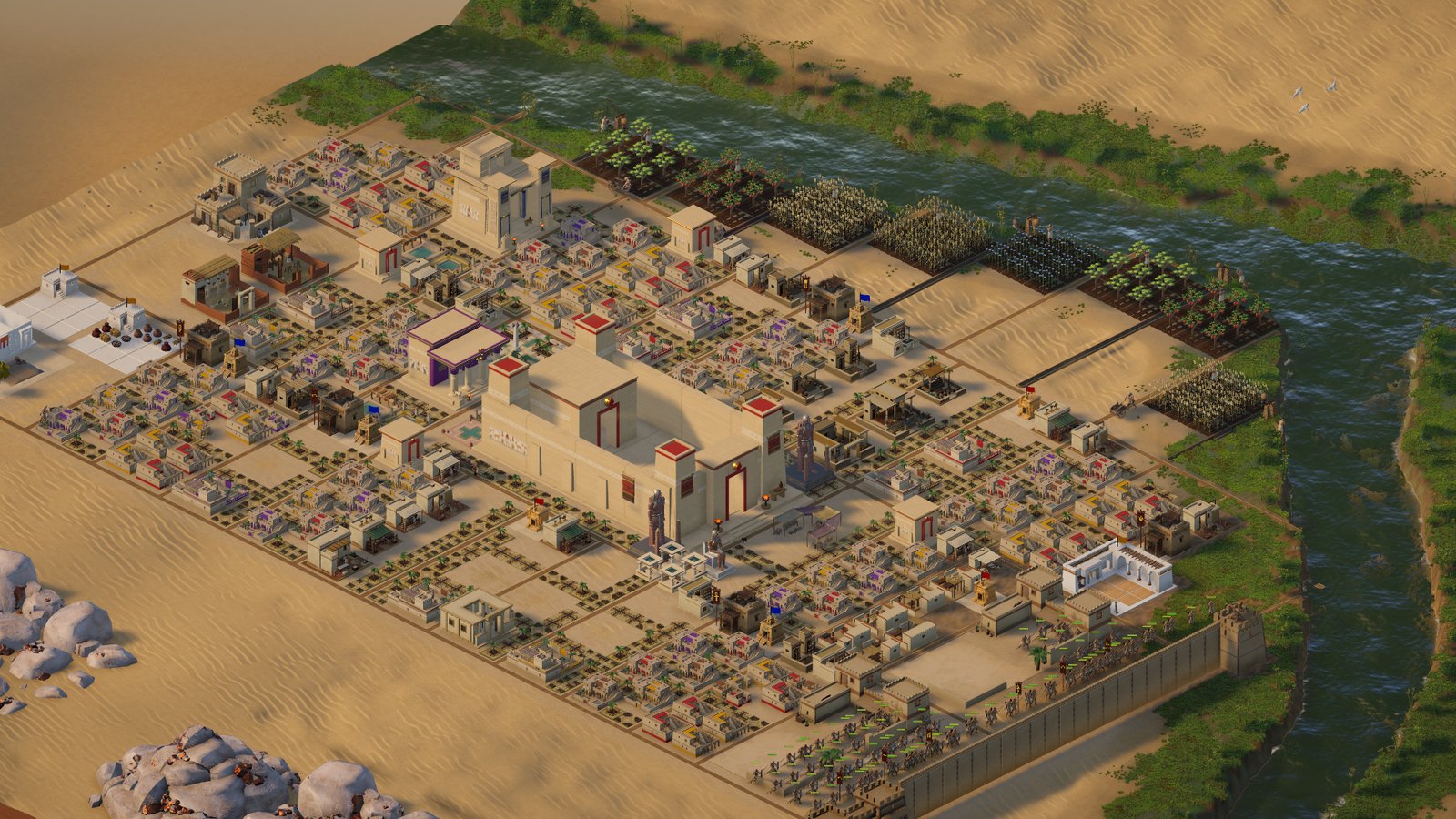
Tjaru, a fortress town I built to test the systems in this update.
Military
The last update covered walls, towers and the Eastern Desert raiders. Since then I have mostly worked on how your own soldiers move.
When you give a squad an order, every soldier now walks straight to his own place. A squad no longer stops to rearrange itself once it arrives, and soldiers on the march walk past comrades who are standing still instead of getting stuck behind them. Their steps match their speed, and spearmen carry the spear in both hands while they march.
Six squads leaving Tjaru through the gate.
A military base now has a yard. Soldiers assemble there and stay out of the built part of the base.
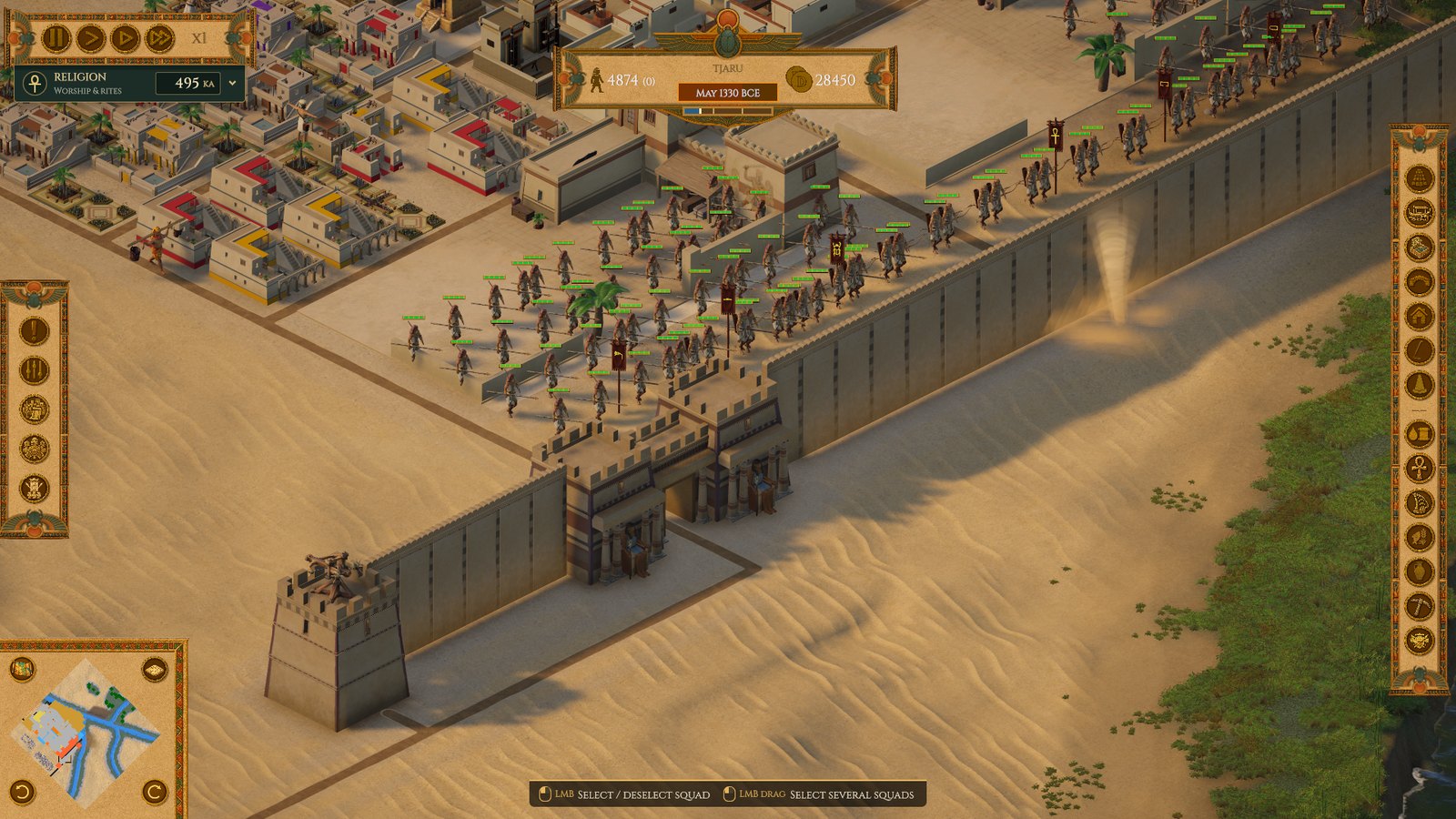
The garrison assembled behind the wall.
Squads can also cross the Nile. Order them to the far bank and they board canoes and paddle over. During the flood, the canoes ride at the height of the water.
Squads crossing the river by canoe.
Raids have had work as well. A fight now has its own sounds: swings and hits in a melee, arrows leaving the bow and landing, and the ballista on a tower. A soldier who falls stays on the ground for a few seconds before he is cleared away.
The people of the city react too. Workers run home, families on the road get out of the way, and they wait until the danger has passed before going back to what they were doing.
Raiders at the gate of Tjaru.
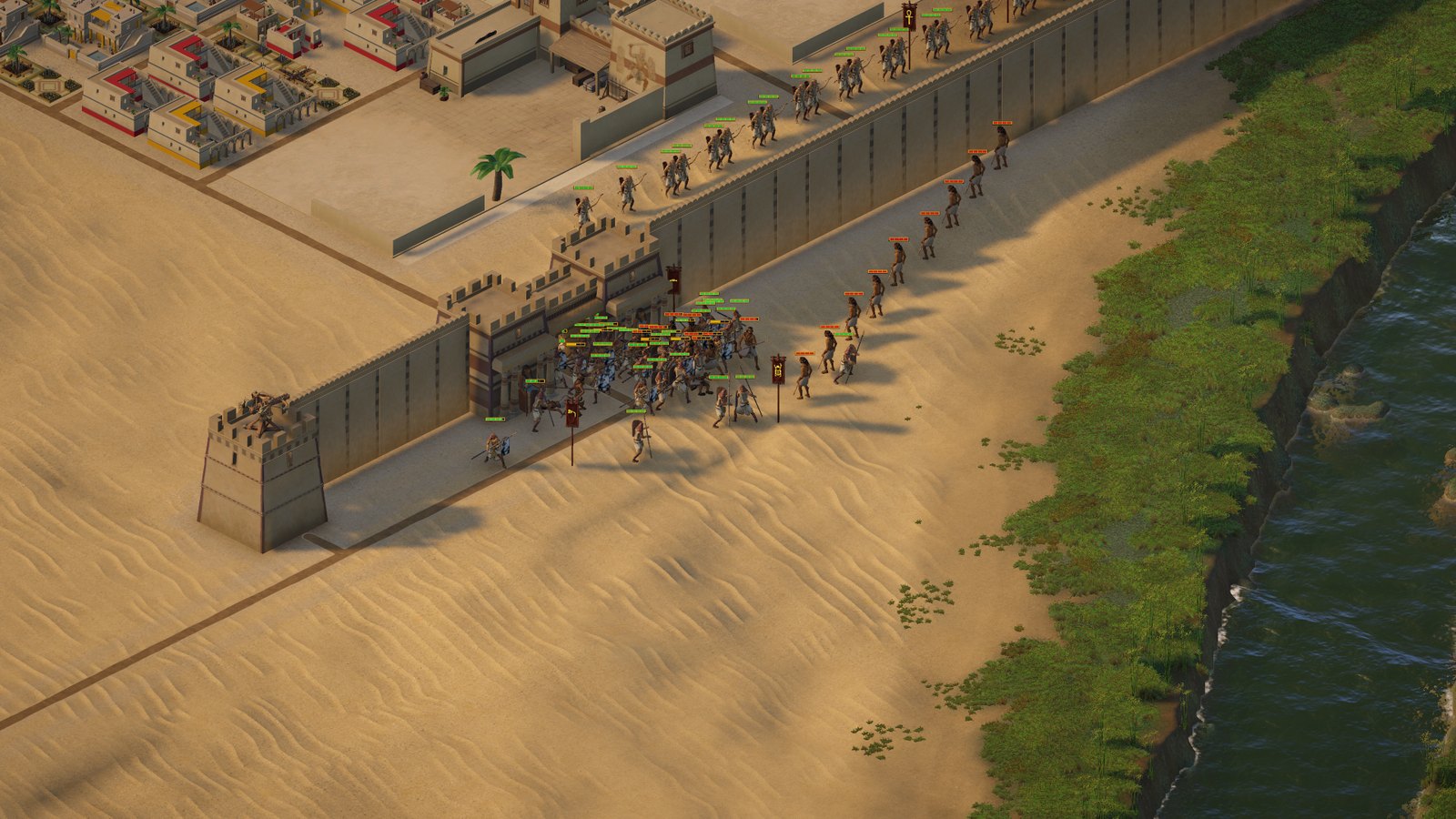
The same fight from further back.
Farming
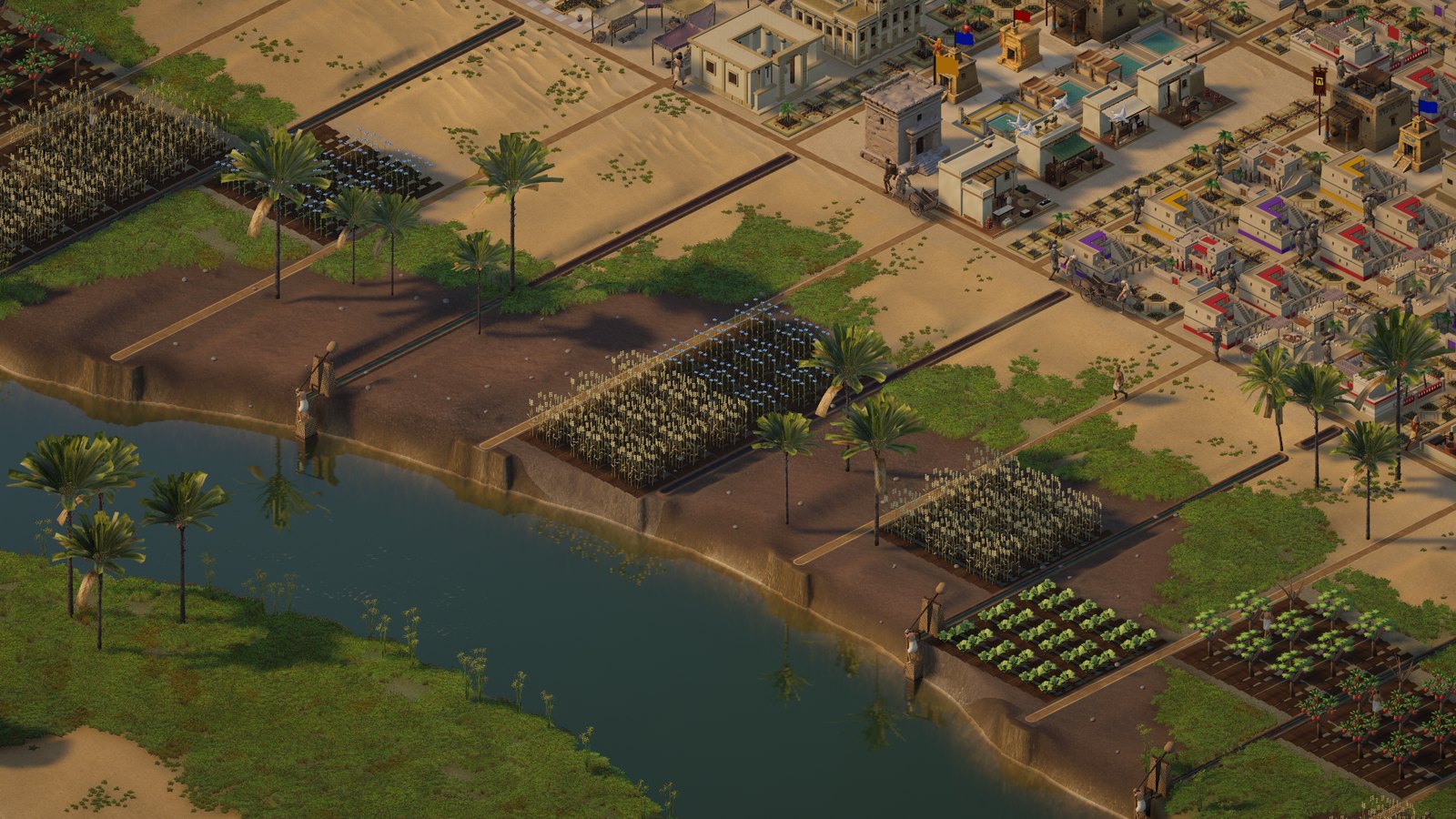
Fields along the Nile at Memphis.
A field now shows its crop growing. Each field is planted in sections that come up one after another, and farmers work among the rows. The size of a harvest depends on two things: how many days of work the field received, and how fertile its soil is.
The crops have new models too. Grain has separate stalks and seed heads, lettuce has broad leaves, pomegranate trees carry their fruit, and flax flowers blue. The rows follow the ground, and everything moves in the wind.
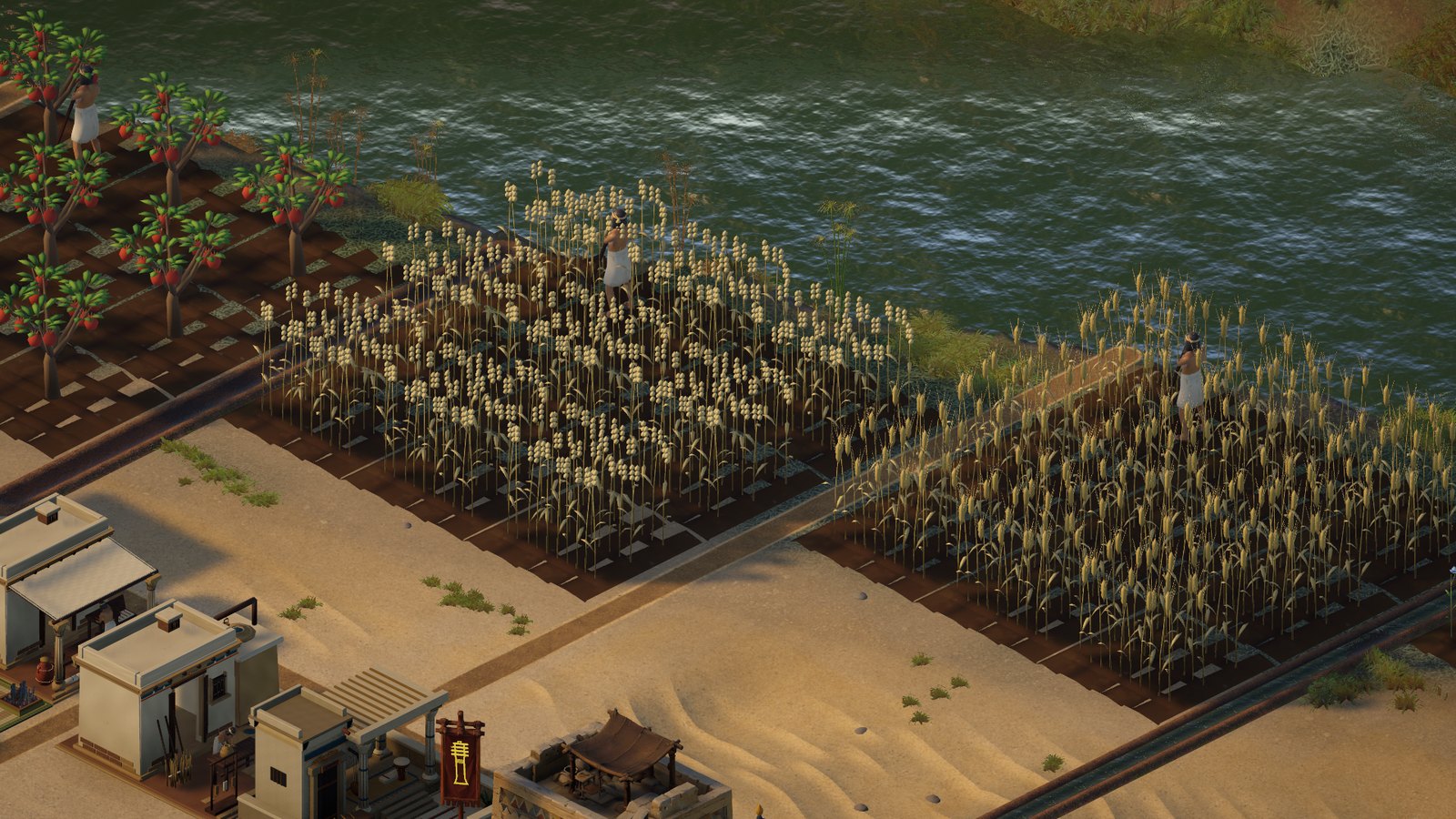
Farmers at work in the grain at Tjaru.
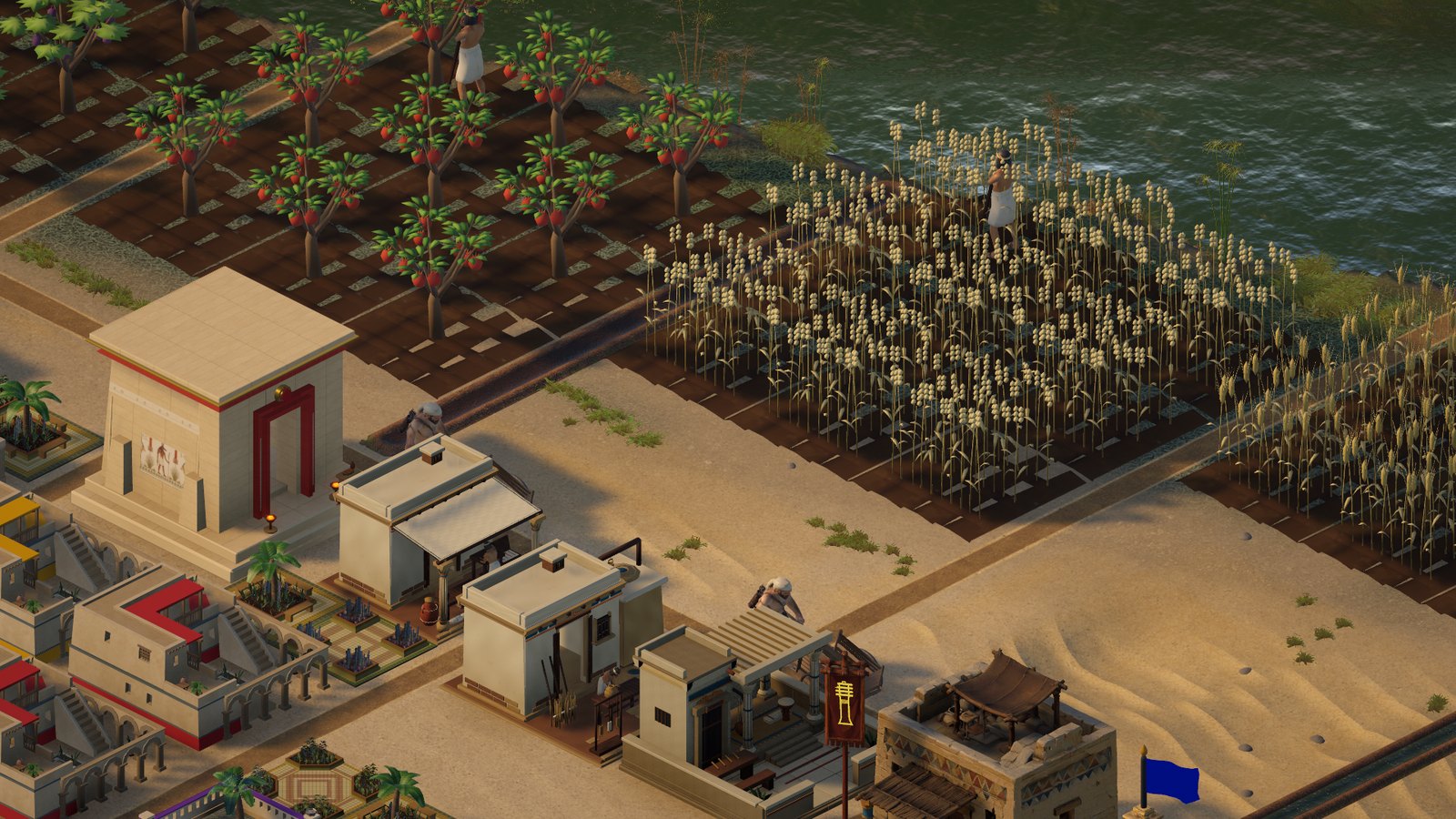
A pomegranate orchard beside the grain.
There are seven crops so far: grain, lettuce, chickpeas, pomegranates, figs, barley and flax. Grain also leaves straw behind, so one harvest supplies more than one part of the city.
Farms on the floodplain follow the river. The flood covers the fields and puts fertility back into the soil, and every harvest takes some of it out again. While the water is up, people on their rounds keep off the roads it has covered.
The flood over the fields at Memphis.
Farms on higher ground, the meadow farms, keep their own harvest months, and they rely on irrigation. A ditch on the floodplain fills from the river. A ditch on a meadow needs a water lift to feed it. Farmland beside a watered ditch is more fertile.
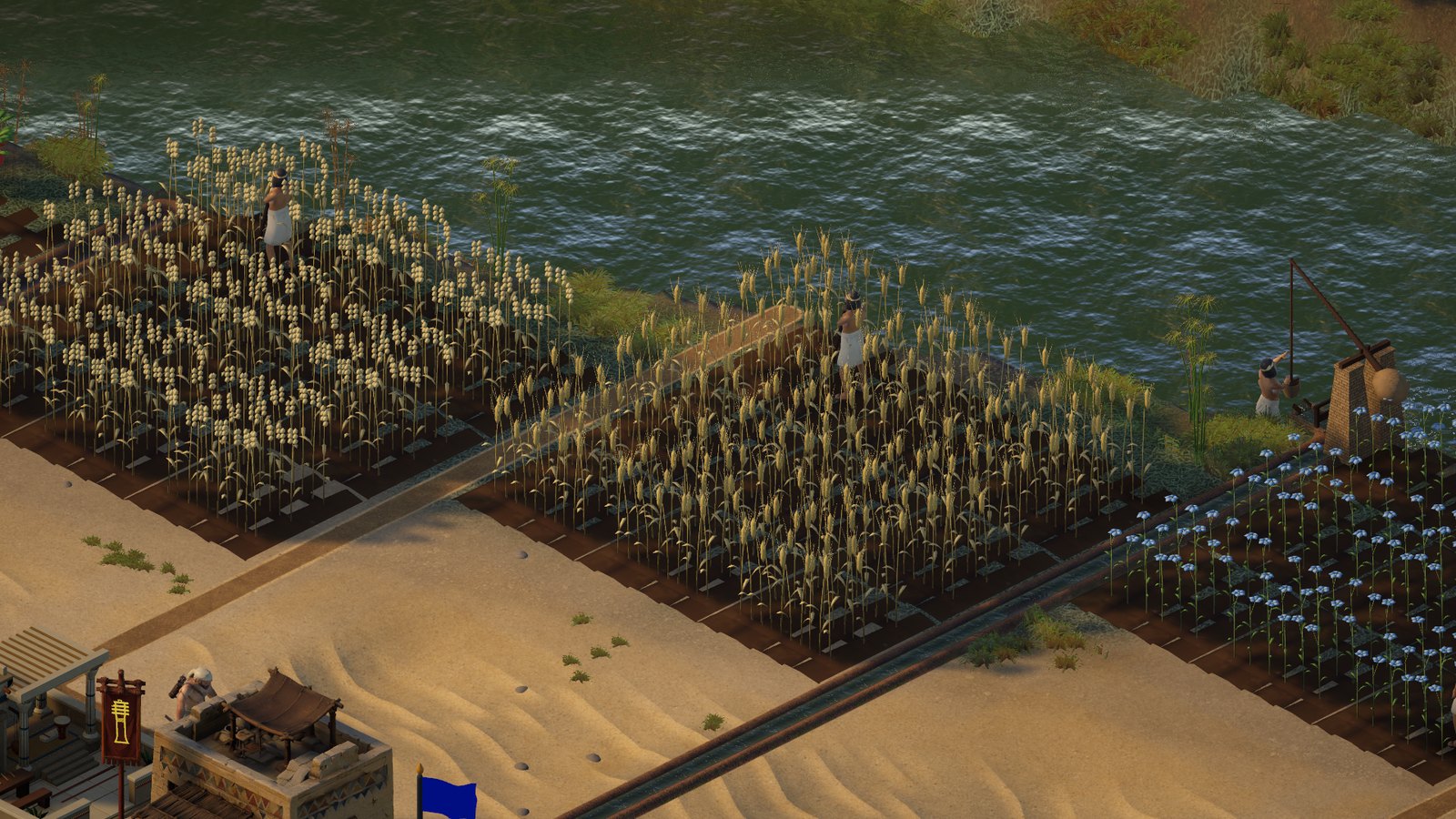
Grain and flax, with a water lift on the river bank.
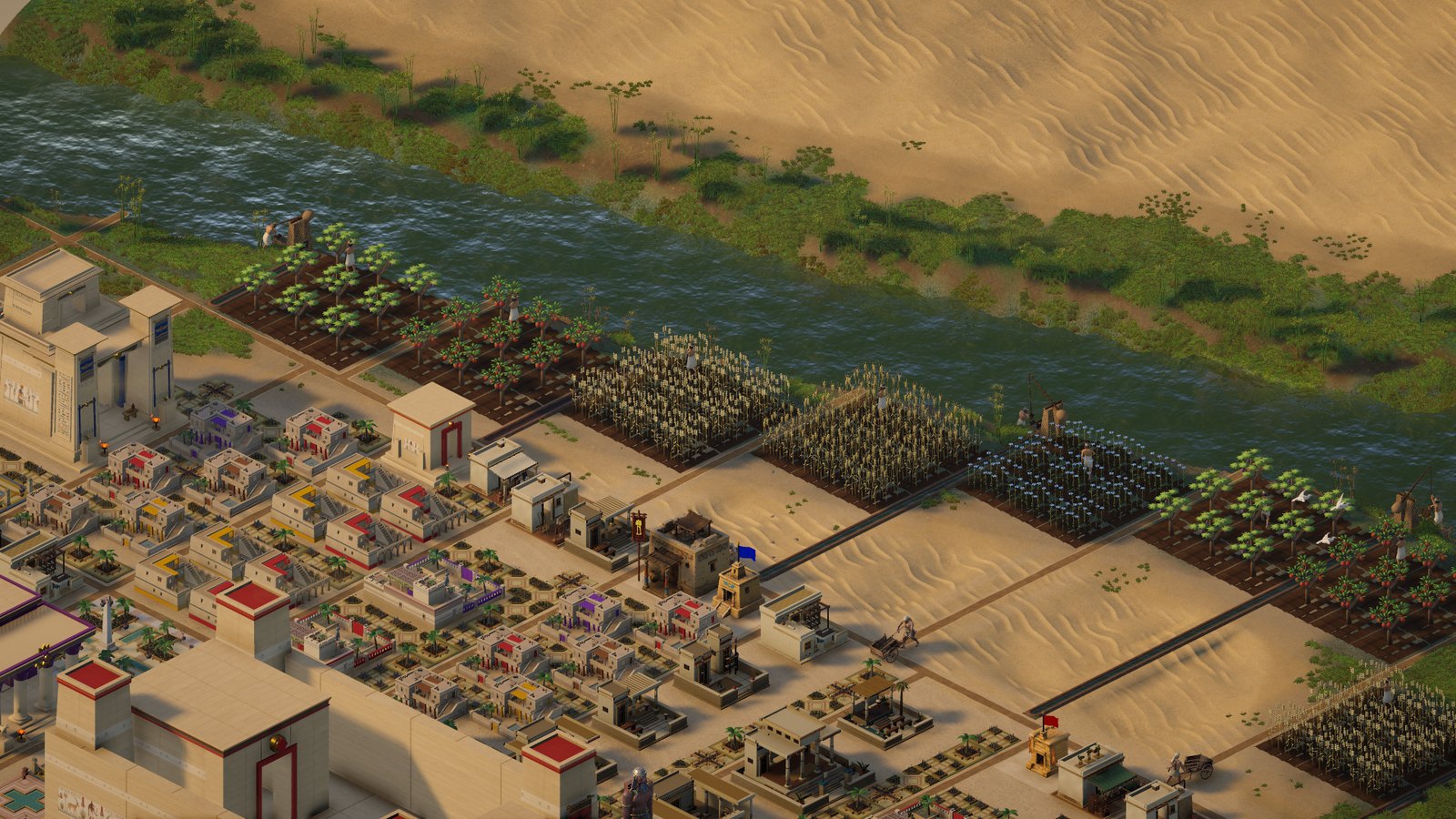
Fields at Tjaru.
Harvest time.
Trade
Memphis can trade with two neighbours: Sinai, by camel caravan, and Thebes, by river ship. Opening a route costs deben. Each route buys and sells its own goods, and it can carry only so much on each visit and in each year.
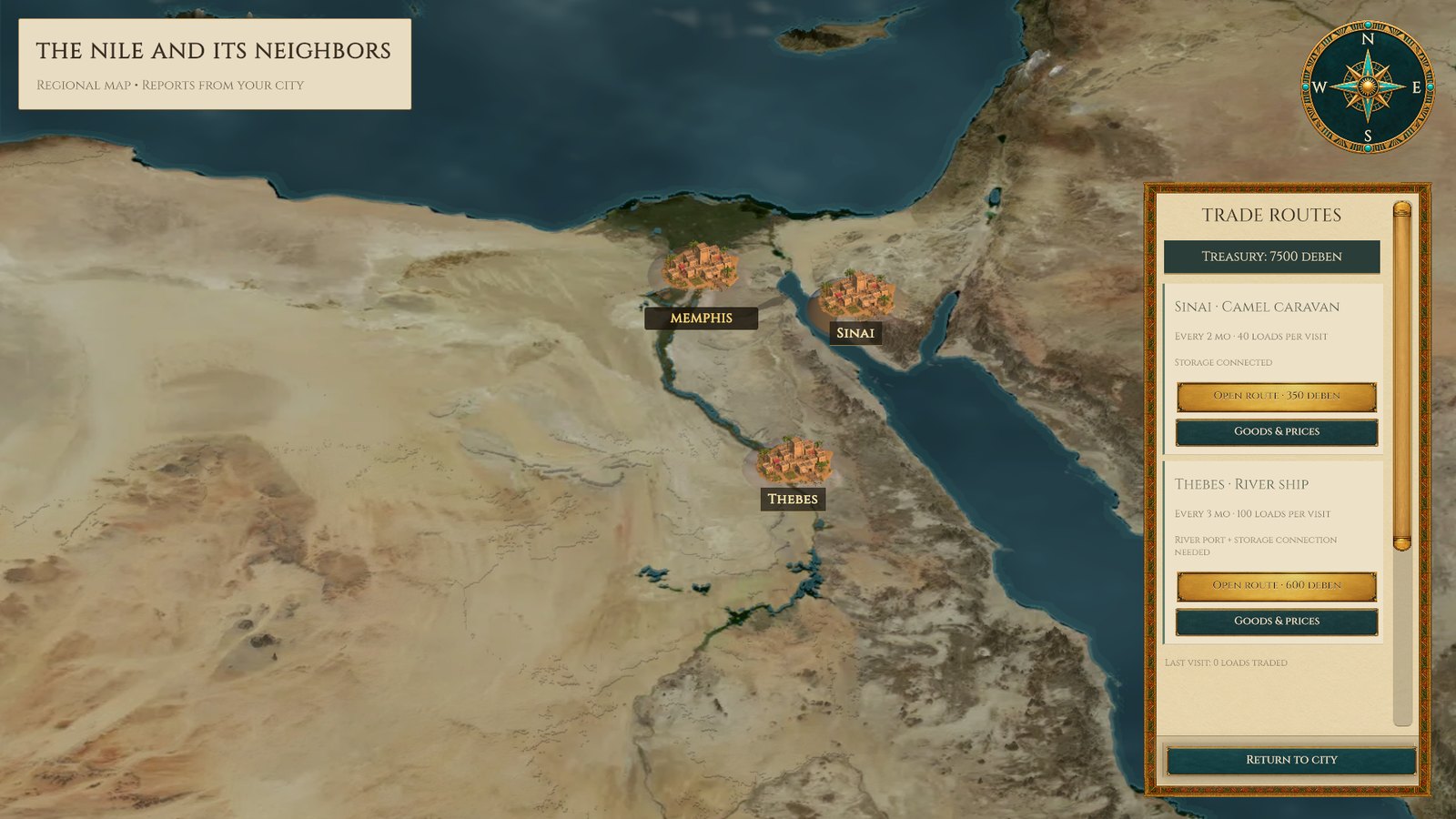
The regional map with the routes to Sinai and Thebes.
For every good you choose one of three policies: do not trade it, buy it until your stock reaches a target, or sell whatever you hold above a target. Selling above a target lets you sell a surplus without emptying the stores your workshops depend on.
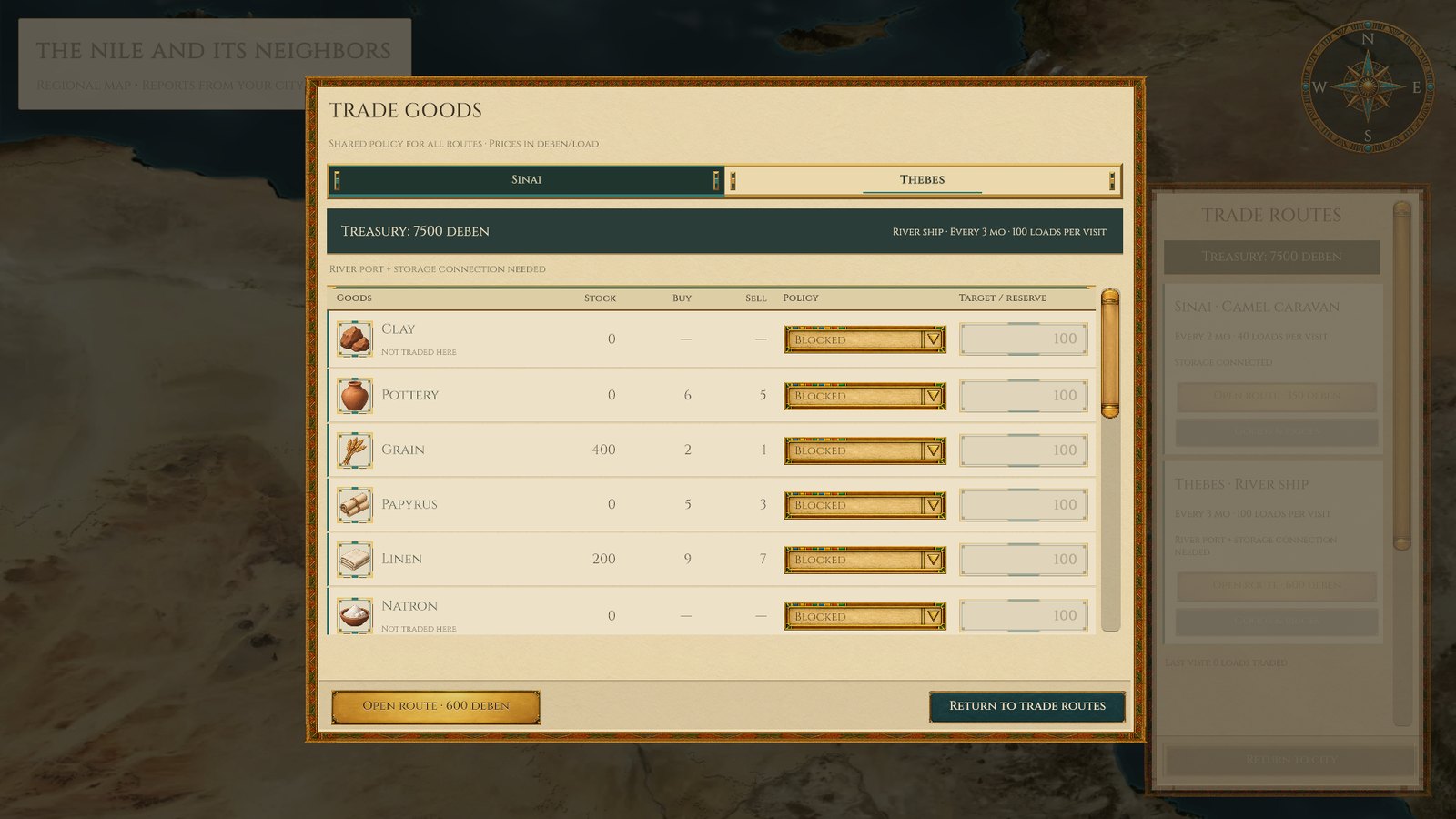
Policies and stock targets for each good.
Opening a route and choosing what to trade.
A route also needs a connection to the city. A caravan needs a storage building that is joined to the roads. A ship needs a river trade post on the bank of the Nile, with a road from there to storage. Later cities can open a third route, to the quarries at Silsila.
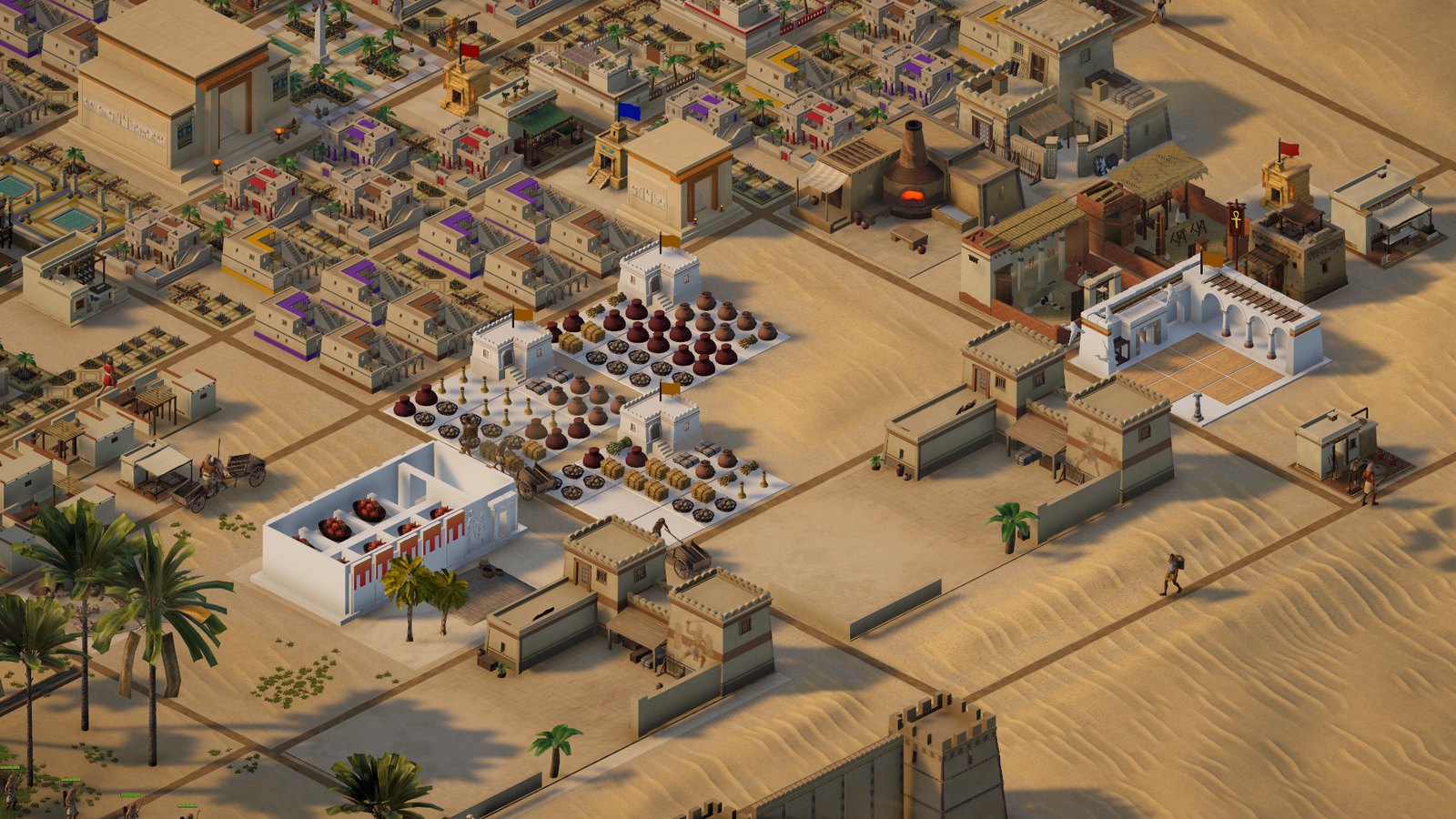
Stores and workshops at Memphis.
Fire
I set a large fire in Memphis to check how flames and smoke look when a whole district burns. In a normal game, firewatch posts send walkers on patrol to keep a fire from getting this far.
Ten buildings alight around the library. This fire was set on purpose for the test.
Monuments, temples and statues
Three cities now have a monument to build: the Amun Colonnade in Thebes, the Ptah Gateway in Memphis and a mortuary temple in West Thebes. A monument goes up in stages. Crews work on the site while hauling teams bring the stone.
A monument going up stage by stage. This clip is sped up.
The build menu has a new Beautification section that holds gardens and statues. Statues come in three sizes, and they need no workers and no road.
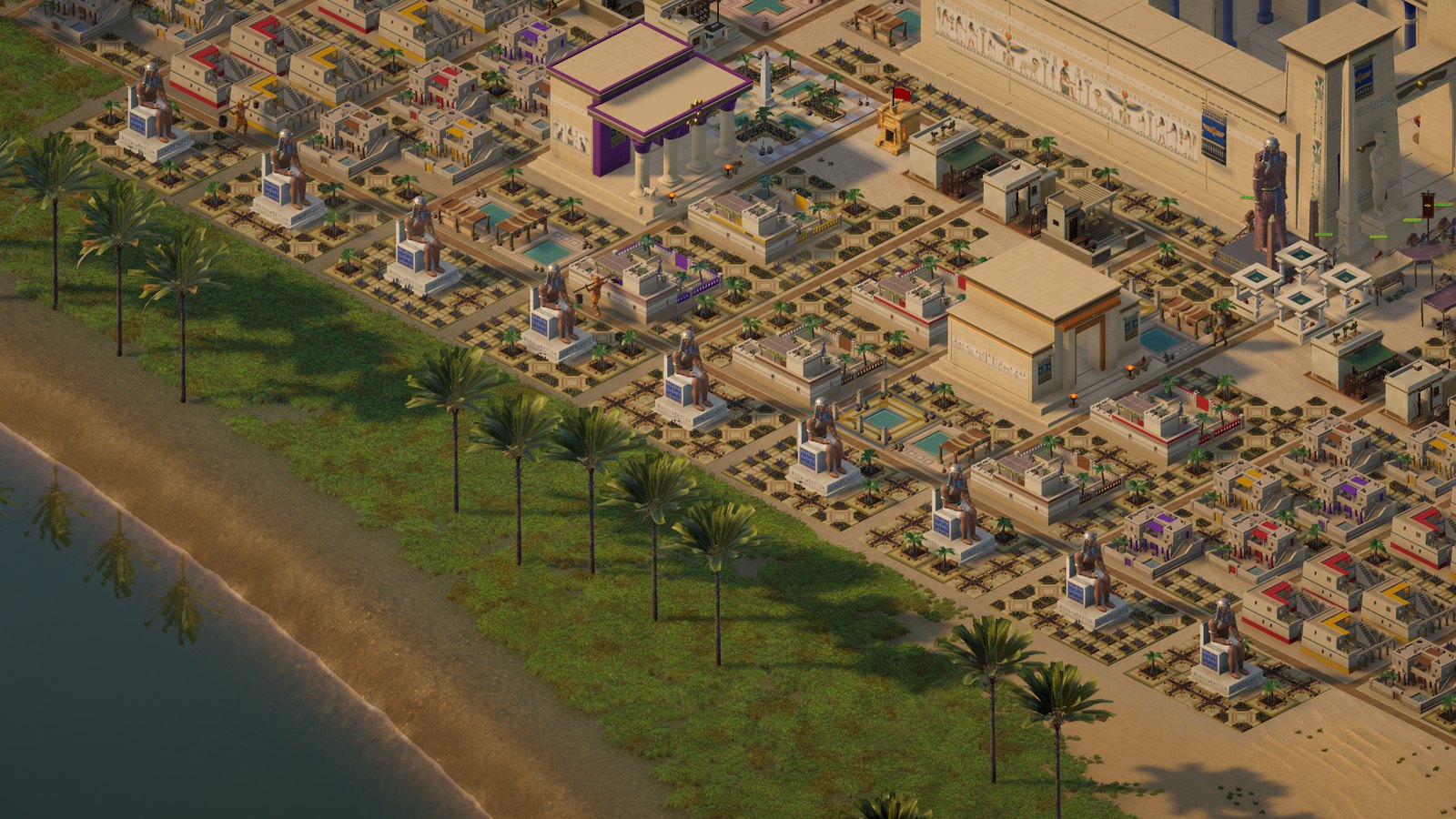
Statues and gardens beside the Nile at Thebes.
Each of the five gods, Amun-Ra, Bastet, Osiris, Ptah and Seth, has a shrine, a temple and a temple complex.
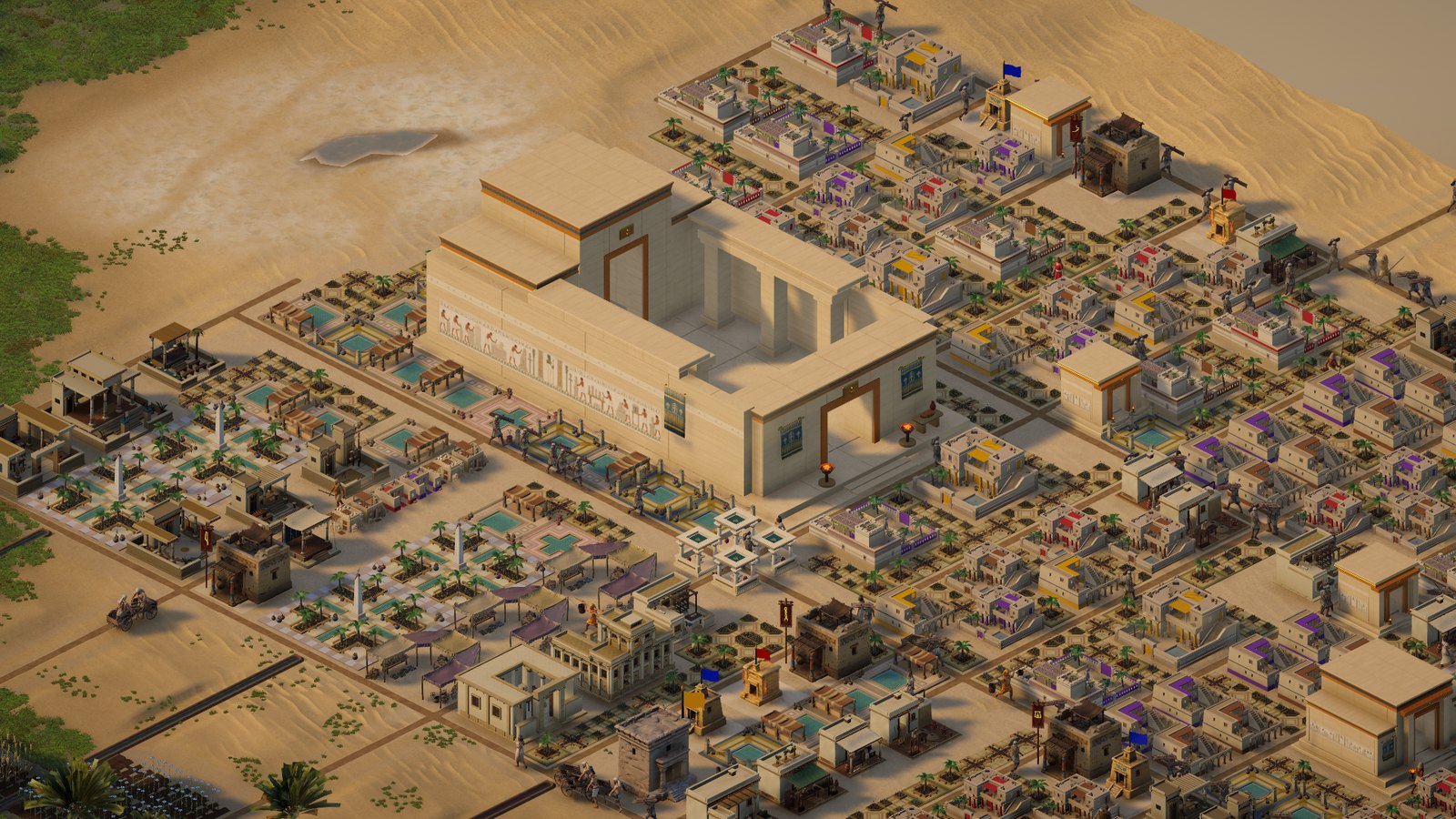
The temple of Ptah at Memphis.
What is next
Priests, festivals and the health services are still in progress, and I will cover them in a later update.
The Steam page has also been refreshed, with new screenshots and clips from the current build.
Thank you for following the development and for your feedback.
Wishlist Tutankhamun: Builders of the Eternal on Steam
Solo Developer
The journey continues.
Explore more updates